Finding the right therapist for you or your loved one can be quite confusing as there are so many available options. So, knowing which is which, and which one is practically the best suit for your condition is very important, not just to save time but also resources. If you’ve ever questioned the difference between Occupational Therapist and Physiotherapist, this article will give you a clearer picture of what each career offers. Both help individuals get independence back and raise their standard of living, making them vital components of the Australian healthcare system. But their approach and concentration differ greatly. Knowing these distinctions will guide you to choose appropriately for yourself or a loved one in terms of care and rehabilitation.
Let’s thoroughly and practically differentiate who does what and when you might need each one.
Role of an Occupational Therapist
An Occupational Therapist (OT) assists you in carrying out the most essential daily activities for your health, independence, and daily living. OT helps you find strategies or assistive devices if illness, accident, or disability makes it difficult for you to carry out these activities so that life becomes easier and more manageable.
For example, if you had a stroke and struggled to dress yourself, an Occupational Therapist could assist you in relearning techniques to do it independently. If your child shows developmental delays, an OT may create exercises to enhance motor skills or boost concentration. To enable someone with a disability to live more safely and more comfortably, an OT could recommend house adjustments such as ramps, handrails, or accessible toilets.
Occupational Therapy is about empowering engagement, helping you to do what you need and wish to do even when faced with physical, mental, or emotional challenges.
 Role of a Physiotherapist
On the other hand, a Physiotherapist (Physio) concentrates on your body’s motions and operation. Through movement therapy, manual therapy, and exercise, they are professionals at increasing physical performance, mobility, and pain control.
You have most likely seen a Physiotherapist if you have ever had back pain, a sprained ankle, or surgery. They evaluate the cooperation of your muscles, joints, and bones and next create a program meant to regain strength, mobility, and coordination.
Physiotherapists sometimes use the following techniques:
- Customised workout routines to help restore range of motion and strength
- Relieving stiffness with massage or joint mobilisation
- Prevention of damage through posture and movement retraining
- Instruction on body mechanics and physical wellness
While Physiotherapists examine how your body carries out the motions required for those chores, Occupational Therapists consider how you complete them. Their aim is to raise your physical state so you can move safely and with ease.
Major Distinction Between Physiotherapy and Occupational Therapy
Simply put, Physiotherapy concentrates on “moving” whereas Occupational Therapy is all about “doing.”
Suppose your shoulder was injured. Working with you, a Physiotherapist would assist you in lowering discomfort and increasing shoulder range of motion. An Occupational Therapist, meanwhile, would concentrate on assisting you to use that enhanced movement in everyday life, such as reaching overhead to grasp anything from a shelf or getting dressed without aid.
Here’s another illustration: if a child struggles to write because of weak hand coordination, the OT might use play-based activities to enhance grip strength and motor control. But the Physiotherapist would concentrate on strengthening those particular muscles to enable better function should the problem be muscular weakness or imbalance.
Often working closely, both have crucial parts in your independence and recovery.
When You Might Need an Occupational Therapist
You might find seeing an Occupational Therapist useful if you:
- Struggle with self-care chores like eating, showering, or dressing
- Need assistance getting back to school or employment following an injury or illness
- Are living with a disability and need tactics or assistive technology to run day-to-day life
- Want help with changing your residence or office for accessibility
- Experience coordination, concentration, or emotional control problems
From hospitals and schools to aged care facilities and NDIS support environments, Occupational Therapists also work across a variety of settings. Their whole approach means they examine your surroundings, actions, and goals in addition to your illness in order to create solutions really suited to your lifestyle.
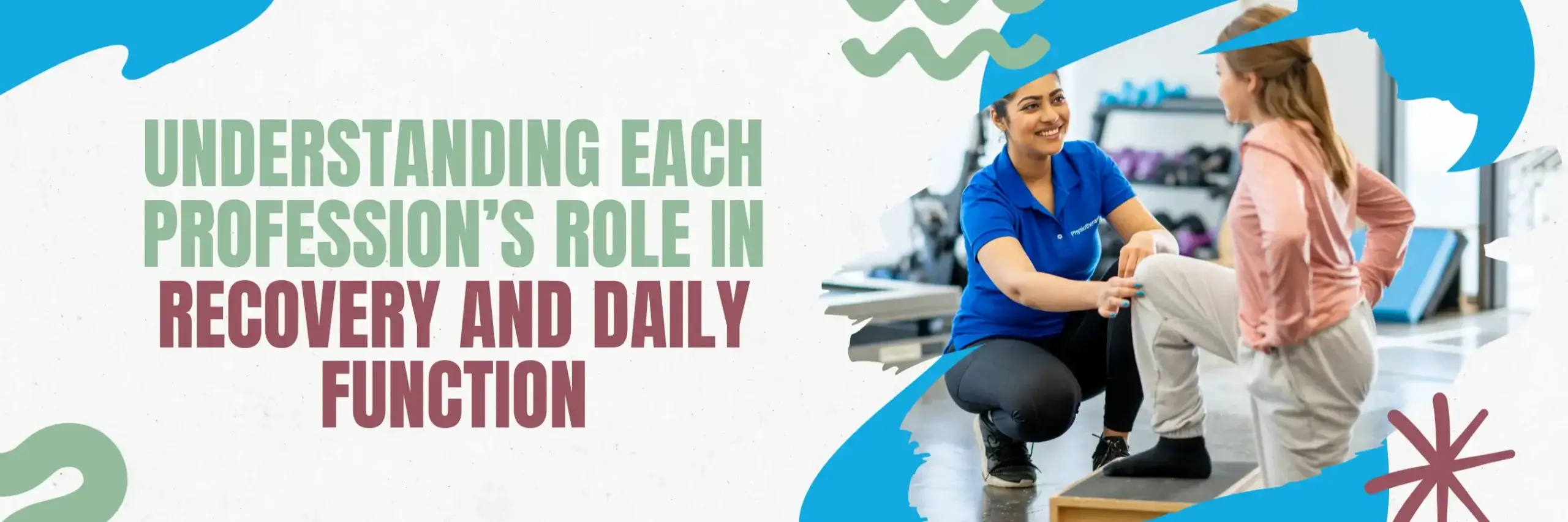 When You Might Need a Physiotherapist
You could need a Physiotherapist if you:
- Have nerve, muscle, or joint pain restricting your movement
- Are healing from an accident or operation
- Would like to increase strength, flexibility, or balance
- Suffer constant tiredness or discomfort impacting your physical movement
- Need rehabilitation after an accident, stroke, or fall
Through science-based exercises and physical therapy methods, Physiotherapists are especially helpful in assisting you to move more freely and control pain.
How They Work Together
Many times, you can see both an Occupational Therapist and a Physiotherapist as part of your care team. Particularly for those managing long-term conditions, recovering major injuries, or living with impairments, this is true.
Under the National Disability Insurance Scheme (NDIS), participants usually get aid from both fields. While the Occupational Therapist makes sure those physical changes result in significant, practical results in daily life, the Physiotherapist could centre on increasing physical function and mobility.
This partnership offers a more thorough and people-centred approach to care, therefore supporting both your movement and your capacity to live freely.
Selecting the Right Assistance for You
Think about your main aim when choosing between a Physiotherapist and an Occupational Therapist.
- Beginning with a Physiotherapist might be your best approach if your major problem is restoring movement or physical power.
- An Occupational Therapist would be perfect if you find it difficult to arrange daily chores or need adaptive techniques for autonomy.
Sometimes the ideal strategy is seeing both. A great healthcare provider will assist you in evaluating your needs and, if required, in coordinating care between the two.
The Conclusion
Though their goals of helping you lead a better, more independent existence are the same, Occupational Therapists and Physiotherapists employ distinct techniques. While Occupational Therapists help you to use that function appropriately in daily life, Physiotherapists seek to improve the physical performance of your body.
Whether you are recovering from an accident or controlling a long-term illness, both are critical in assisting Australians recover, adjust, and flourish.
At Optimal Care Australia, our qualified Occupational Therapists get to know your objectives and create customised strategies to simplify daily life and make it more satisfying. We are here to help you regain independence and live bravely every day, whether you are looking for assistance at home, in your community, or via the NDIS.